The Madesh draught is currently making national headlines but is not a new issue. While historically struck by dry spells every two or so decades, though, the region has been facing more droughts in recent years. A warmer climate and more erratic rainfall patterns are partly to blame. Yet, many localise the root cause to destructive activities up in the lower hills running adjacent to the Madhesh, namely in the Chure belt.
The Chure belt and its low hills along the flat Madhesh has undergone dramatic physical changes in recent decades. It used to be a landscape of forests on the ridges and slow-flowing rivers in the valleys, rich in dense vegetation cover and natural river basins. This allowed rainwater to be retained and ponds to be filled. Thus, local aquifers were also easily recharged. Today, it has become a scared and significantly drier landscape.
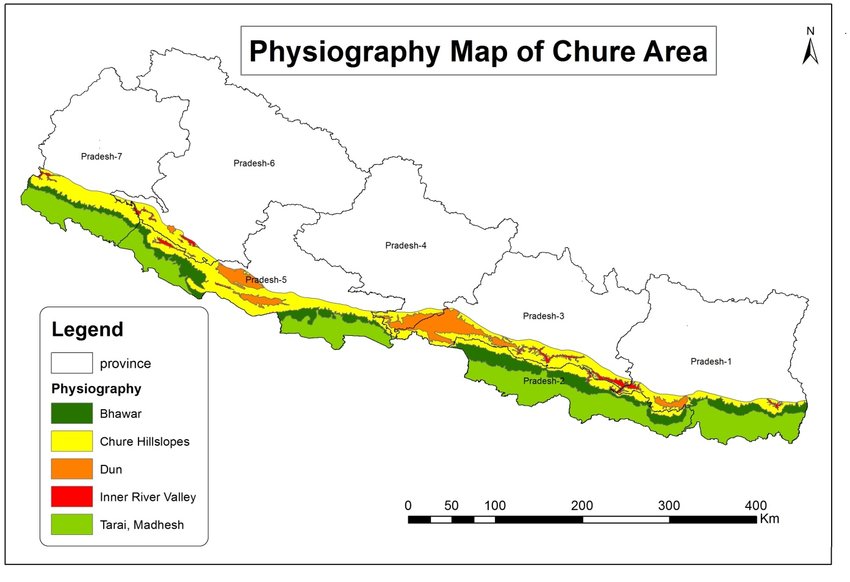
The Chure belt and its low slopes and Duns (or valleys) parallel to the Terai/Madhesh zone. Kathmandu Post, 23 May 2024.
While natural springs used to provide all-year water for the local population, locals in still more villages have to walk far to find a water source. In short, the water level is dropping as natural springs are drying out. The effect of these dramatic changes in the once lush Chure belt are also felt on the fields of the Madhesh. Not only is the water level decreasing, forcing farmers to drill ever deeper to pump up irrigation water. Floods along the rivers have also grown in both severity and frequency.
A degraded Chure region means cascading risks downstream. Saswata Sanyal, ICIMOD, Kathmandu Post, 22 August 2025.
Making matters worse, illegal and indiscriminate logging has drastically reduced the forest cover on ridges and slopes. In addition, Substandard road construction has left many slopes scarred and allowed ever more intense monsoon rains to wash away soil cover and destroy natural springs and ponds. Making matters worse, relentless river mining has exposed aquifers and turned once slow-flowing rivers into canal-like water ways, allowing rainwater to flush unhindered downstream, creating massive floods.

Excavating, dozing, and quarrying: scenery from the increasingly scared landscape of the Chure belt. Kathmandu Post.
In short, human activity has destroyed forests and natural recharge zones and water barriers which once maintained a high groundwater level. Now, more and more villagers in the Chure belt are reporting dried-out wells, and some are even forced to relocate. In the Madhesh and other districts downstream, farmers dependent on irrigation face a growing threat to their income and livelihood. If water levels continue to drop, they either have to invest in deeper boring or give up farming.
The big question on everybody’s lips is: why has nobody done anything to prevent the situation in the Chure from getting worse? Indeed, some have, even the government itself. The “water crisis” and the “drought crisis” have been long time in the making, and some action has taken place. However, as many regret, there are other interests than “access to drinking water” and “farmers’ livelihoods” at stake. Those interests explain part of why actual steps to correct the mistakes in Chure are weak.
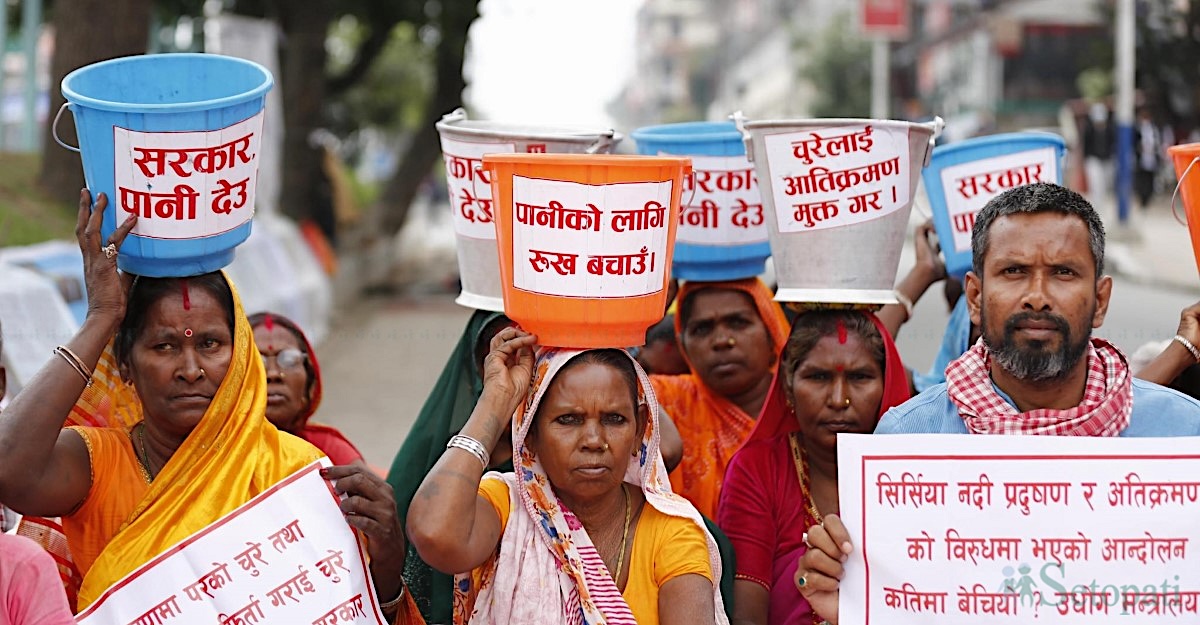
Locals in Kathmandu to complaint that illegal logging has dried out springs in many districts. Setopati, 23 May, 2025.
The Chure belt is faced with local politicians who may have been elected by local voters, but who have often acted to the detriment of local voters’ expectations. In cahoots with local bureaucrats and “business interests”, some have turned a blind eye to indiscriminate logging, relentless river mining, and irresponsible road construction; and some have indeed taken part in the “corruption” themselves, thereby leaving Chure and the Madhesh to sink deeper into a “state of no return”.
The ‘Chure-Tarai-Madhesh Conservation and Management Master Plan was approved by the cabinet of ministers on May 4, 2017. Since then, the board has been doing various programs… Kathmandu Post, 23 May 2024.
The enlargement of the local government units in 2017 may have accelerated this growing disaster. This enlargement brought along bigger local budgets, which were officially envisaged to pave the way for larger and more meaningful infrastructure projects. However, it also meant a many-doubling of the size of local constituencies which were now costlier to cover in local election campaigns than the small constituencies in the past. Local politicians often faced bigger expenses.
Local politicians who needed money to run costlier election campaigns often accepted bigger “donations”, and with bigger donations followed obligations to provide larger benefits in return. Local bureaucrats will take bribes and commission for issuing illicit licenses, manipulating public tenders, and “turning a blind eye” to misconduct, often informally instructed by “higher-ups”. Meanwhile, local politicians would rush to plan roads and ensure that local campaign contributors got the contracts.
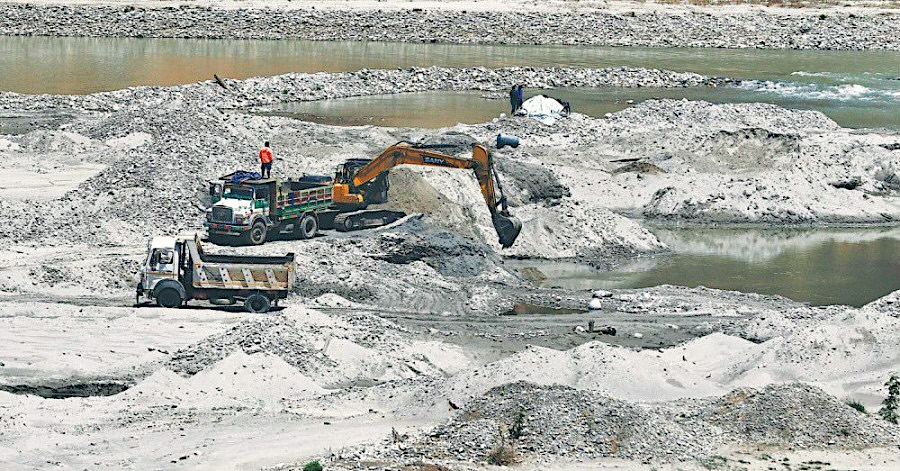
Letting destructive and illegal extraction of raw materials continue: here river mining. Keshav Thapa, Kathmandu Post.
The mix of incentives involved is complex to cover in full. At a glance, however, some incentives include “needs” to “satisfy campaign contributors” who want contracts or licenses; “secure electoral support” among voters who sometimes also ask for more roads; make “party workers content” who sometimes demand to sit on the “road user committees” where “illicit earnings” can be made; and “obey higher-ups” who instruct “corrupt schemes” of all kinds and penalise disloyal acts of local “cadres”.
Not all local politicians are, necessarily, indifferent to the deteriorating conditions in the Chure belt. However, from a “practical” perspective, it can be difficult for them to stand up and “act differently”. As long as the incentives to continue “corrupt activities” remain strong, not only for the sake of “self-enrichment”, perhaps, but also for satisfying local supporters, campaign contributors, local senior staffers, and higher-ups, few local politicians are likely to take a stand.
The first mistake was made by the government. It was a mistake to let contractors extract sand and boulders from the river beds without regulating them. Forestry user groups chairman. Nepali Times, 2015.
As the Chure water crisis seems to arise in great part from “political” and “corrupt” incentives and practices, laws and enforcement are still important. Yet, they might not solve the problem on their own, as things stand. In light of the fact that impunity is rife, “lawmaking” and “law enforcement” will only have some effect. Unless political and economic players in the Chure belt and at higher levels begin to see “changing practices” as an advantage, chances are that mischief will continue.
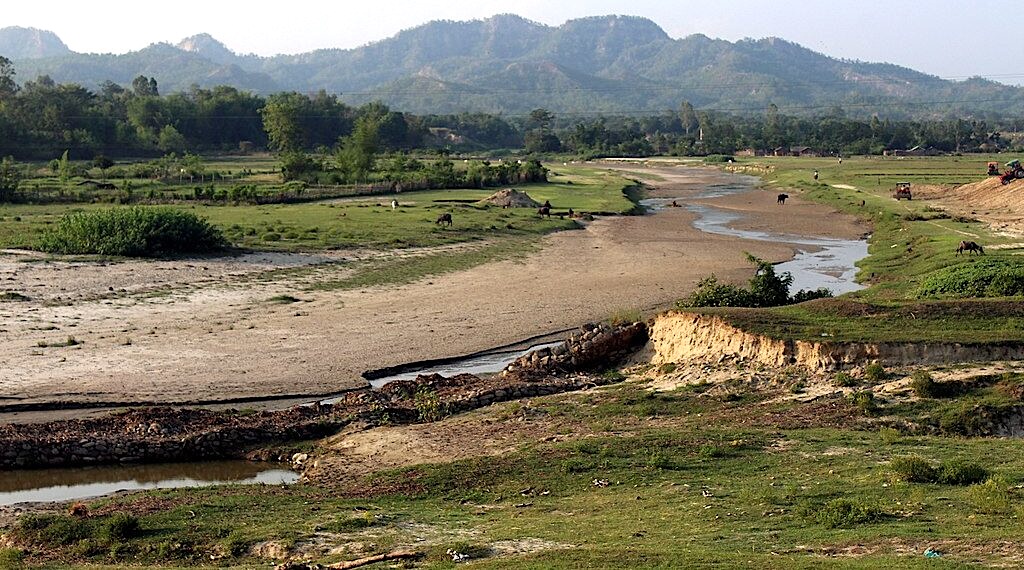
Still beautiful scenery left in Chure for future generations to enjoy: but for how long.
These thoughts can at least come up when looking at the situation in Chure. Sadly, local bio-diversity is also adversely affected, leaving future generations with less wildlife and natural beauty to enjoy if nothing is done. The “Chure problem” is just one of many in which incentives are skewed in favour of corruption and mischief, not decisions of long-term benefit to wider segments or the local community as a whole. It is a deep-seated problem, and until incentives change, it is likely to persist – also in Chure.
Extras
Some leave nuanced incentives aside and assess the root cause of the Chure crises and the consequent Madhesh drought to simply lie in collusion between politicians and bureaucrats at all levels and contractors and illegal groups seeking to maximise profits and bribes. If gains are on the upside, it may take a lot, then, to turn the situation around. From local contractors to smugglers from India, many seek to transform Chure’s natural resources into cash as much as possible.
The demand for pebbles and boulders, sand and gravel, and tropical timber is massive in Nepal and south of the border. Until demand in the construction industry contracts significantly, incentives to continue the extraction of raw materials in Chure will likely persist; and with the tendency of politicians at all levels in Nepal to exchange political favours for political support as well as a share in the proceeds, and of bureaucrats to turn a blind eye for a bribe, it is hard to be optimistic.
The culprits of the degradation of Chure are all too familiar: The sand, land and timber mafia that is only interested in making a profit and the three tiers of government that have no regard for the present and future of the nation. Kathmandu Post, 23 May, 2024.
The right of a country like Nepal to make revenue from its natural resources cannot be denied, some also add. Indeed, many “industrialised countries” extract resources as well. The issue is the manner in which it is done, namely without proper planning and coordination, let alone environmental impact assessments or analyses of consequences for water supply locally and downstream. The big profits of a few versus ever rising costs for the many is a huge “policy issue” – and it’s left unresolved.
Your take?
If you have a view on the water situation in the Chure belt and the Madhesh, do share it in the comment box below. We hope to follow up with a further analysis on the situation next time the Chure water crisis and the Madesh drought make headlines.
