While an interim government is coming together in Kathmandu under Interim Prime Minister, Sushila Karki, the “local level” are still counting their losses. Hundreds of local government office buildings were looted and set ablaze, many of them burned to the ground and others still standing but unusable. Among those worst hit is Pokhara metropolitan city which lost, not only most of its headquarters, but also a staggering 26 of its 33 ward offices, plus nine municipal vehicles.
In Kirtipur municipality, also badly hit, the six-storey municipal building burned to the ground, 10 vehicles and 22 motorcycles were torched, and computers and documents went up in flames, causing a loss of estimated one billion Nrs. In Biratnagar, the four story headquarters met with the same fate. In Birgunj, their office building burned for two days, all equipment and documents either stolen or burned to ashes. The table below lists the damages counted so far.
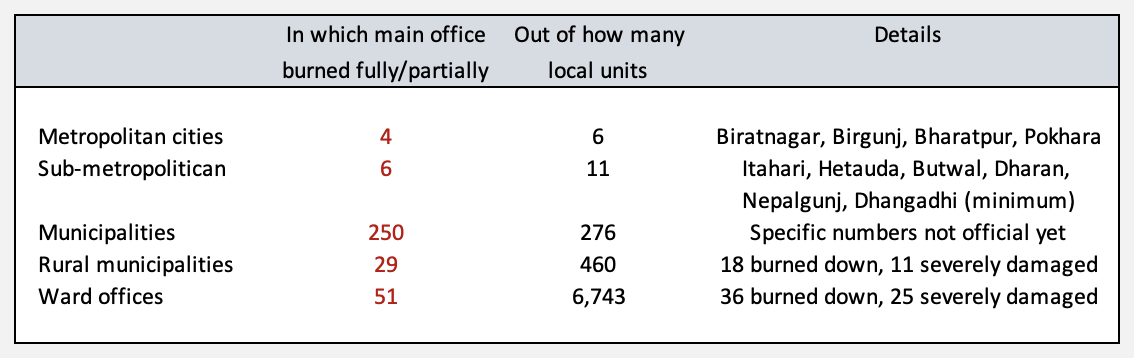
List of local units in which the main office (headquarters) was burned down fully or partially.
Several metropolitan mayors lost their homes along with their workplaces. This happened to the mayors of Pokhara, Itahari, Birgunj, Bharatpur, and Birendranagar. Says former Bharatpur Deputy Mayor, Adhikari: “They blasted gas cylinders inside my house. I built it with decades of hard work. Now I own nothing but the clothes I’m wearing.” Meanwhile, it is widely reported that “several” municipal mayors also lost their homes, although specific numbers have yet to come out.
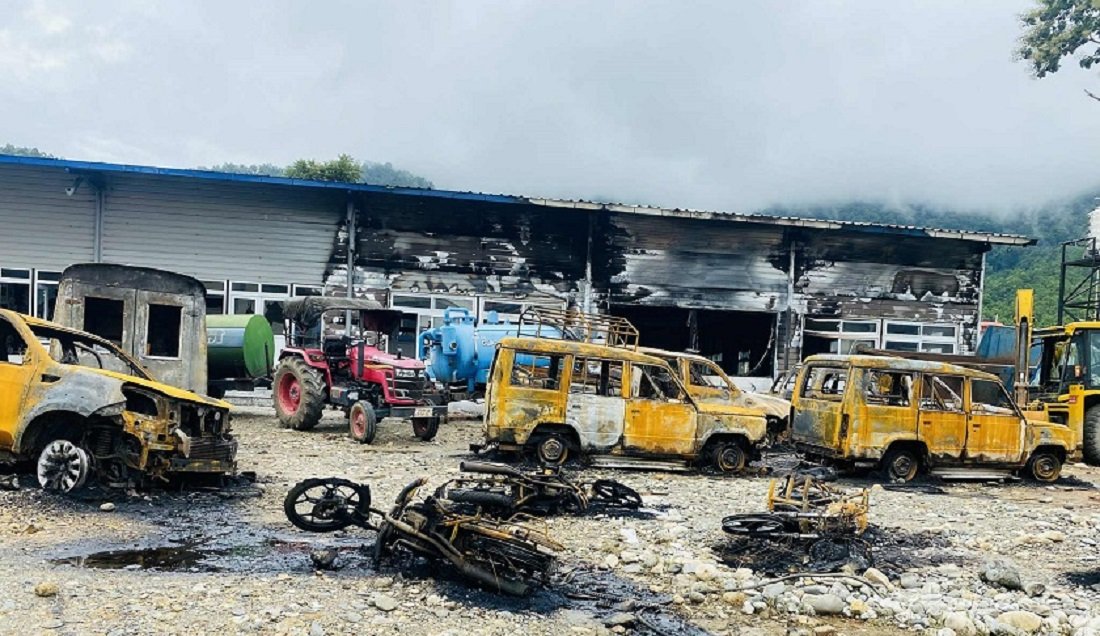
Destruction is counted in billions of rupees: burned out vehicles at the compound in Hetauda.
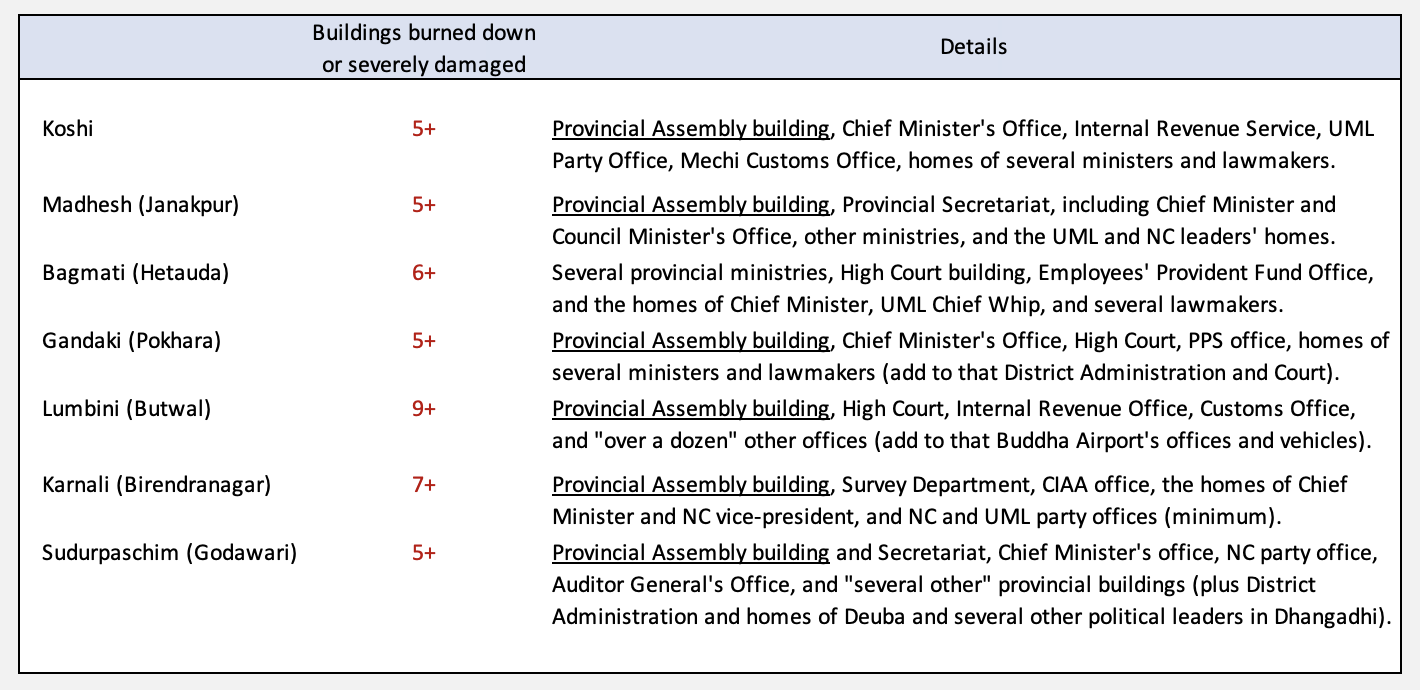
Mayors know only too well that help might not reach anytime soon. The provincial headquarters have also been torched with no provinces spared. All except Bagmati Province, all lost their Provincial Assembly buildings, all the Chief Minister’s office, the secretariat building, and in many provinces the High Court’s office. In Gandaki, who had recently started their own Provincial Public Service Commission, also this building was set ablaze. It was indeed a systematic overrun.
As an interim cabinet is taking shape in Kathmandu, local elected officials face yet a new reality. Their “leaders” in the government will no longer be elected leaders of government or opposition, but instead nominated “bureaucrats” and “technocrats”. In light of the scale of corruption taking place within Nepal’s ministerial bureaucracies, state corporations and agencies, the medical sector, and the education sector, not least, facing such a cabinet may have implications.
The interim government will likely entail a rupture in existing “patronage ties” and “brokerage networks” between local elected politicians, provincial representatives, and ultimately “party bosses” in the capital. However, while federal-level “bureaucrats” and “technocrats” may have “party links”, to be sure, and follow political instructions, those handpicked by Sushila Karki and the people around her are supposed to have other “loyalties”, namely towards the “formal system”.
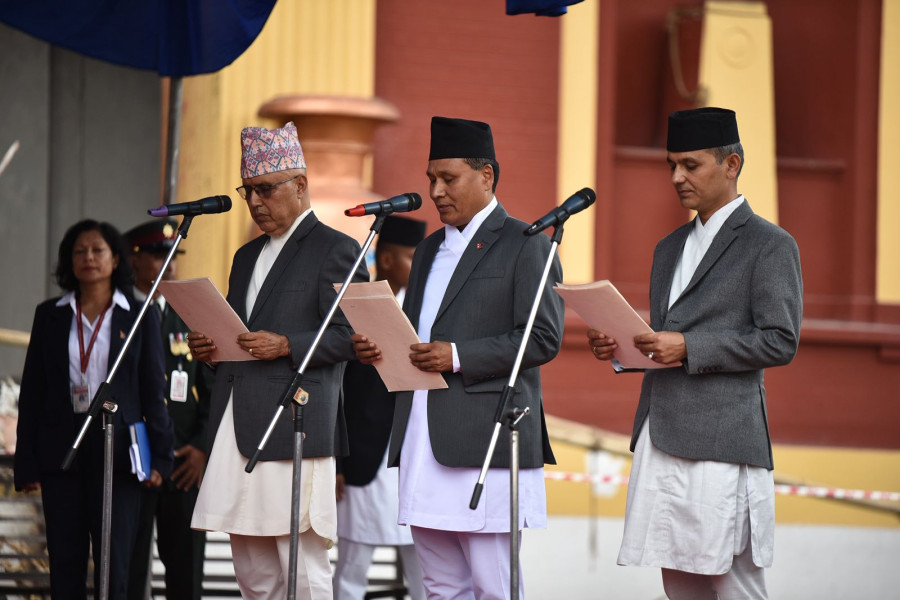
A former secretary, an executive director, and a noted lawyer: a emerging new cabinet disrupting old “channels”
The implications for local as well as provincial politicians when it comes to seeking access to resources, negotiating budgetary issues, and solving other problems facing the local and provincial level at this point, could be great whatever the “loyalties” might be. With their “channels” of access and communication in likely disarray, local and provincial politicians may seek to develop new “ways in” to have a share in budgets and other resources, as “old relations” might not work.
How the new interim cabinet will connect and work with the local and provincial level will likely be important in many respects. Local and provincial patience might allow for some postponement, as everybody is acutely aware of the massive scale of the attacks and the task of reconstruction and reestablishment of operations. Yet, after some time, they will likely demand substantial help. Few local and provincial bodies will be able to get back to speed entirely on their own.
Documents were burned, valuables looted. We have nothing to work with. Deputy Mayor Shubhalaxmi Shakya (Kathmandu Post, 14. Sept. 2025)
If Sushila Karki and the Gen Z leaders, who chose her as their representative, are to turn the idealistic goals and principles stated immediately after the uprising into reality, one major step will be to bring local as well as provincial government bodies back in shape. At least, elected local and provincial representatives will expect some show of effort. How the interim cabinet will respond will be part of what defines its popularity at the “local level” and will be a central aspect to monitor.
Extras:
As underlined, the counts above are preliminary. Numbers just in from Dhangadhi illustrates what the ultimate count might look like. The DAO reports that 108 government buildings were torched, vandalised, or looted along with 600 vehicles, including 100 four-wheelers and about 500 motorcycles. Eight or nine party offices and homes of local leaders were set on fire, as was the DAO office itself, the District Court, Land Revenue Office, and the Survey Office – and they are still counting.
Sources for the tables in this article:
Gen Z protests leave over 300 local units offices in ruins
Violent protests sweep the nation. Offices and leaders’ residences torched
Gen Z protests leave trail of destruction across nation
Hetauda Metropolitan City Destroyed by Genji Movement
Gen Z’s actions in Butwal, viewed in pictures
Chaos in Dharan in the name of Zenji: Party offices and leaders’ houses vandalized
Protesters set fire to Itahari sub-metropolitan Office
